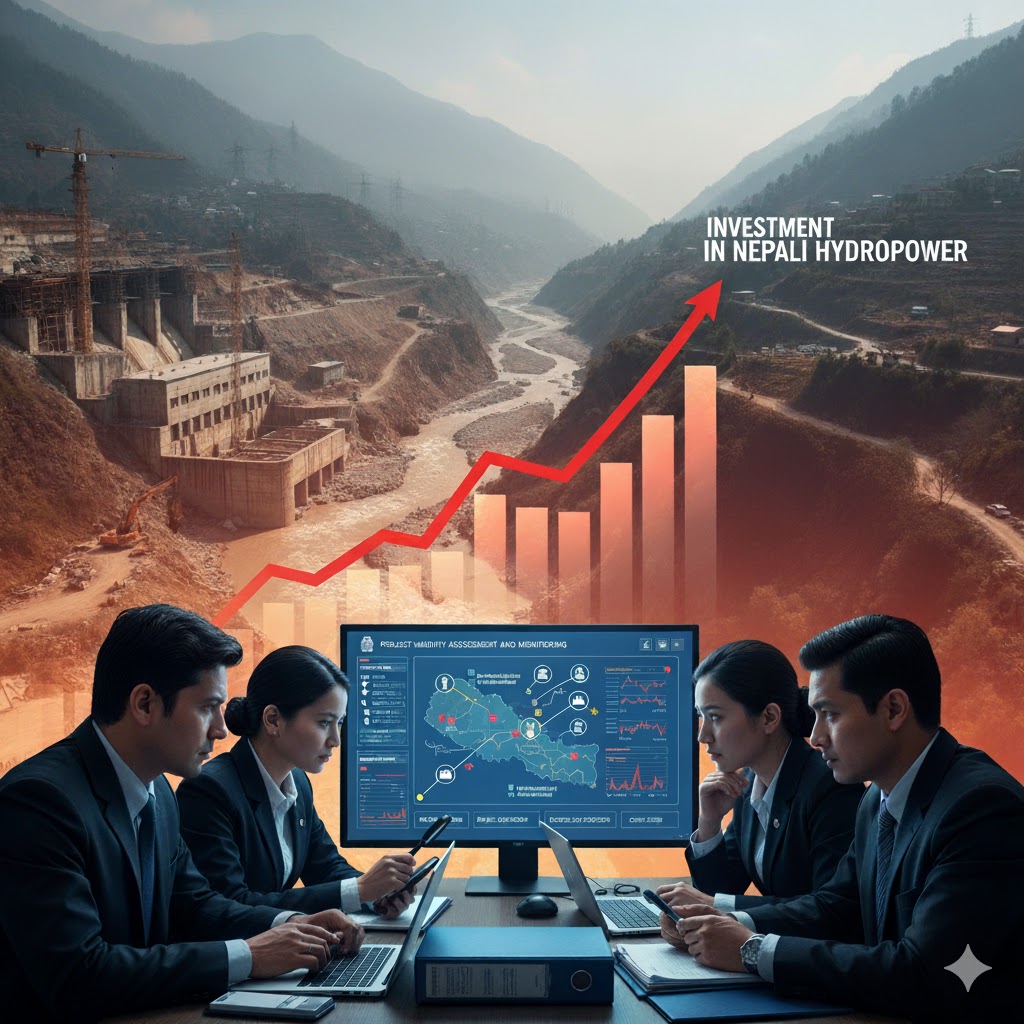
Over the past three decades, Nepal has witnessed tremendous progress in realizing her hydropower potential utilizing the private capital. The policy ecosystem designed for the energy sector has continuously encouraged Banks and Financial Institutions (BFIs) to lend massive amounts of capital required for hydropower projects. As a result, more than hundred hydropower projects have been built and are supplying electricity to the national grid. In addition to the capital injected by BFIs and promoters, the general public are also given the opportunity to invest through Initial Public Offering (IPO). This kind of financing scheme in hydropower projects has brought the entire nation to have its stake and receive return from the natural resource it endows.
To date ninety-four hydropower project companies have already issued IPO and are listed in Nepal Stock Exchange. Similarly, many hydropower project companies are in the pipeline to issue IPO. So far, on average the hydropower companies have fared well and delivered modest returns to the shareholders. As the number of hydropower projects grows and the public money — BFIs debt and IPO — keeps financing the significant chunk of project cost, it is imperative that we ask what could go wrong and become vigilant. It is in the greater public interest to know if we have the required monitoring systems and agencies in place to ensure whether the public money is safe. Whether or not the shares are issued to the public, it is essential to ask the question: who should monitor the hydropower projects? But in a circumstance where an IPO is issued to the public and promoters have an easy exit option, answer to this question becomes paramount and should be communicated clearly. Furthermore, it is also the correct time to discuss this issue as BFIs have currently auctioned a few hydropower plants on the occurrence of default by the hydropower project company.
Who Should Monitor Hydropower Projects?
Monitoring has different forms. Several stakeholders associated with hydropower projects — licensing authority, BFIs, promoters, consultants, local people and many more — have different scope and interest in monitoring depending on the stage of the project. Department of Electricity Development (DoED) — the licensing authority — grants project license and requires the project to be transferred to the government free of cost and in a good operating condition at the end of the license period. To ensure that the project is in a good operating condition during transfer, DoED prima facie appears responsible to monitor the hydropower projects. But we need to ask a question: is DoED an appropriate stakeholder to monitor hydropower projects? Sometimes voices have been raised that DoED should monitor the project during both study and construction phase to ensure the project remains in a good operating condition at the time of transfer.
Realizing the transfer condition, DoED from its very beginning had a mandate to monitor the hydropower projects. It appears that DoED right from the start have correctly identified its role and extent of monitoring it needs to engage for. To preserve the productive efficiency attainable by engaging the private sector in the design-construction-operation phase, DoED has limited its monitoring exercise to the compliance of guidelines. DoED, a governmental body with limited resources and competence, can not monitor all hydropower projects extensively. Even if DoED had required resources and competence to monitor, the bureaucratic monitoring exercise will kill the very objective to engage the private sector and develop a project in a cost-effective manner. DoED has published guidelines related to the study, design, operation and maintenance of the hydropower projects. Compliance to these guidelines attempt to ensure the dual objectives. First the design of the project remains sound tailored to the topographical and geological conditions of the site and developers face minimum interruptions in generation. Second and the crucial objective is that the project shall stay in good operating condition at the time of transfer.
But the topographical and geological complexities involved, size and scheme of the project demands expertise and intense due-diligence in design, operation and maintenance (O&M). The guidelines of DoED can command the general design but can not guide the detailed design exercises. Moreover, the monitoring of a project must continue during the operation phase as well. The project company needs to have proper corporate governance and sound O&M practices to ensure timely and complete debt servicing. DoED however does not have an authority to regulate corporate governance of the project company and neither should it possess such an authority. Now the question arises: who possesses the right to monitor comprehensive aspects of the project and the project company? The right answer to this question is that the BFIs who lend capital to the project have proper rights and enough incentives to monitor the entire phases of the project until the debt is repaid in full. In the subsequent section, we shall discuss why the BFIs need to monitor the project exhaustively.
Why Banks and Financial Institutions?
Hydropower projects are capital intensive and need higher leverage for financial feasibility. BFIs finance up to eighty percent of the total project cost and need to make sure that any risk associated with the project is either mitigated or has a proper mitigation plan. If something goes seriously wrong, the project company might default and loan recovery could become extremely difficult. Depending on the size of the loan, the balance sheet of BFIs might be strained. Currently, BFIs are lending to an increasing number of hydropower projects with installed capacity above 100 MW. With such large exposures if the due-diligence and monitoring exercises are not up to the mark, default due to any reason whatsoever could severely impact their balance sheet. Consequently, this sheer amount of risk involved with financing hydropower projects incentivize the BFIs to perform greater due-diligence and continuously monitor the project as well as the project company.
When it comes to monitoring the project there are costs associated for which resources are needed. Hydropower projects are complex, require diverse expertise which demands significant financial resources. As a result, the transaction cost becomes high while structuring a project finance deal for hydropower projects. The high transaction cost permitted and considered normal in the project financing process provides ample financial resources to BFIs to procure required technical expertises. In contrast, DoED can not afford costly procurement of such expertises.
In addition to the resources and incentives, BFIs also entail exclusive rights over the project to carry out monitoring exercises. The loan agreement signed between the project company and BFIs allow BFIs to carry out due-diligence, involve independent consultants for review of works and bill verifications, enforce financial covenants, control revenue of the project, establish cashflow waterfall and other monitoring measures to ensure sound financial health of the project company. These provisions protect BFIs by ensuring the project company is not exposed to default conditions. It is therefore evident that the significant stakes held by BFIs in hydropower projects give them strong incentives and sufficient resources to closely monitor these projects until the debt is fully repaid.
Critical Aspects to be Covered in Monitoring
A multitude of aspects needs to be monitored, however, we shall discuss critical aspects that need to be carefully monitored by BFIs. First and of paramount significance is the study and design of the project. BFIs should ensure whether the project company has performed necessary technical studies and whether the design is based on the findings of such studies and realistic assumptions. Project companies to minimize the cost of technical study could perform sub-standard study and base their design on unrealistic assumptions or rule of thumb. Projects designed and built with unrealistic assumptions and thumb rules potentially face serious technical and operational issues during operation negatively impacting the financial health of the project company. BFIs are currently performing due-diligence of the project by appointing a third party consultant. However, there are concerns in the industry that due-diligence exercise is primarily focused towards quantity estimate, rate analysis, project cost estimate and financial analysis. The intensity with which these items are analyzed far exceeds the degree in which the adequacy of study and technical design is reviewed. BFIs should find a balance between the review of the adequacy of study and design compared to the financial risk and financial analysis.
While talking about the study and design, it is necessary to understand that BFIs engage with projects very late. BFIs in Nepal typically engage with projects only after a generation license is issued and a power purchase agreement is signed. By then, it is often too late to address study gaps or design flaws. At this point of time, since the focus shifts to rapid construction and early generation, rectification becomes difficult. It is therefore necessary for BFIs to reconsider the timing of their engagement. Ideally, BFIs should engage with the project not later by the fourth year of the survey license period which shall allow sufficient time to review and improve study adequacy and design.
Second, cost control should be of utmost priority to BFIs. Regarding cost control, the financial covenants in loan agreement require the project company to finance any cost overrun using equity. But the practice has shown that at the event of cost overrun, BFIs have remained flexible to supply additional debt to the project. Such flexible behavior displayed by BFIs has eased shareholders in the event of cost overrun and has killed the private sector's spirit of building within initial estimates. The flexible attitude of BFIs to finance cost overrun when compounded by their lax measures in review of works and bill verification at the site could further render perverse incentives to the project company to slip away from initial budget estimates. BFIs should be strict to their financial covenants regarding cost overrun and follow prudent practices in cost control.
The financing model of hydropower projects which is gaining popularity in Nepal involves IPO to local people, migrant workers and local public. To preserve and continue this investing spirit, they must feel their investment is safe and shall receive projected return on their investment. If the real return on investment erodes due to cost overrun, operational and governance issues, the local public becomes reluctant to invest in hydropower projects. Manifestation, if such, could negatively impact Nepal's ambition to develop her hydropower resources. Third aspect is thus to carefully monitor the corporate governance and O&M practices of the project company. Since BFIs have explicit control over the project revenue, they entail rights to largely contain the corporate governance issues. Nonetheless, the O&M practices need to be cautiously monitored and BFIs should require project companies to establish sound O&M systems.
The fourth and the most important aspect to be considered by BFIs is the exit option of the promoters. Promoters subject to the conditions of loan agreement are allowed to liquidate their shares after the lock-in period concludes. To achieve speedy development of hydropower projects, promoters have been permitted to liquidate shares after the conclusion of the lock-in period and recycle equity. However, this provision does entail downside as well. With this provision in place, promoters have enough incentives to liquidate their shares, gain return from the capital market and generate capital for new projects. But, if the promoters with significant stake and expertise to build, operate and maintain the project are permitted for complete liquidation, sustainability of the project could become an issue. Further, if such practice becomes common, promoters could find perverse incentives to build a project in a sub-standard manner. Therefore, BFIs should find a balance between enabling promoters to recycle their equity for new projects and ensuring the long-term sustainability of the project.
Final Remarks
The hydropower sector in Nepal has progressed remarkably through private capital and public participation with BFIs playing a central role in financing. But, as the public and BFIs lending to hydropower projects continue to rise, it is essential to reinforce monitoring mechanisms to safeguard the financial and operational sustainability. Although DoED ensures regulatory compliance, it lacks the resources and mandate for continuous oversight. Nevertheless, DoED needs to manage the resources and design monitoring systems to ensure that the projects stay in good operating condition at the time of transfer. In contrast, BFIs, having significant financial exposure, resources and contractual rights, are best positioned to monitor hydropower projects until debt repayment, which normally extend fifteen years from commercial operation date. To mitigate the risk of default and protect public investment, BFIs must enhance due-diligence in design, identify appropriate timing to engage with the project, enforce strict cost controls, guide and cause to uphold corporate governance standards, and cautiously manage promoter exit strategies — all aimed at ensuring long-term sustainability and maintaining investor's confidence in Nepal's hydropower development.
Disclaimer: The views expressed are the personal opinion of the author and do not reflect the views of the institution to which he is affiliated.